Free shipping across EuropeIHSA certified1-year warranty
Proof Center

Every number, and where it came from.

9 test documents from 6 independent organisations across both products, all published here in full. A hydrogen figure means little without the method, the volume and the conditions behind it, so each one comes with all three.

ProductWhat was testedByMethod / standardDateResult
BottleDissolved hydrogenH2 Analytics (US)Headspace gas chromatographyMar 20245.14 mg/L · 1.08 mgReport
BottleCertificationIHSAIHSA criteria, tested by H2 AnalyticsJun 2024CompliantCertificate
BottleDissolved hydrogenH₂HUBB (US)H2Blue titrationMay 20254.75 mg/L avg · 5.01 peakReport
BottleOzone & chlorineH₂HUBB (US)Contamination testMay 2025Not detectedReport
BottleHeavy metals & electrode metalsSGS (US)EPA 200.7 / 200.8 · ICPJul 2024Not detected · incl. platinum, titaniumReport
BottlePFAS (21 compounds)Eurofins SwedenDIN 38407-42 · SWEDAC accreditedFeb 2025Not detectedReport
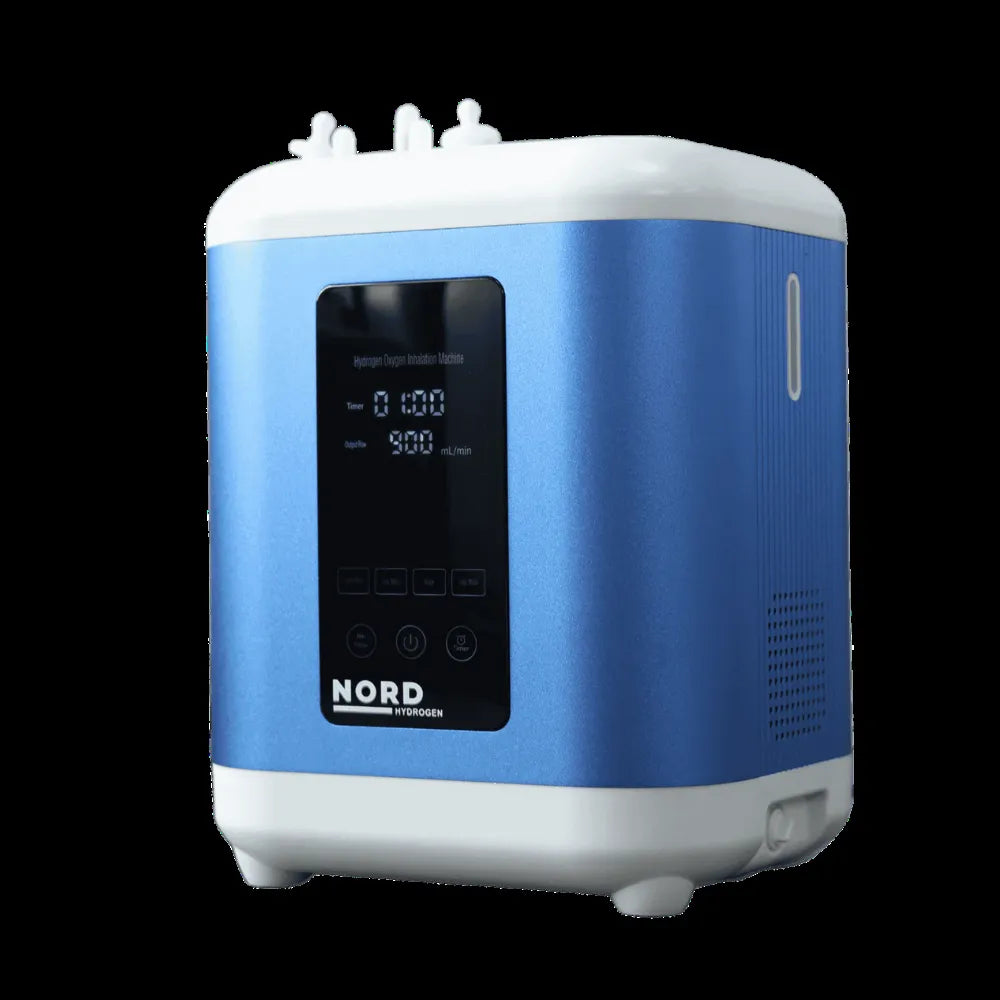
Inhale 2.0H₂ flow rateH₂HUBB (US)Alicat mass flow meterMay 2025661 mL/min · 93% eff.Report
Inhale 2.0Electrical safetyAccredited test labCE-LVD · EN 60335-1, EN 622332024CompliantQQT202407106SC
Inhale 2.0EMC & RoHSAccredited test labCE-EMC · EN IEC 55014 · RoHS 2011/65/EU2024CompliantQQT202407106EC · RC
First page of H2 Analytics laboratory report H2A-24032601
H2 Analytics · Henderson, Nevada · 26 March 2024

Dissolved hydrogen by gas chromatography

Report H2A-24032601

5.14 mg/L
10-minute cycle · SD 0.69
1.08 mg
available H₂ per fill · 10 min
3.44 mg/L
5-minute cycle · SD 0.16
0.72 mg
available H₂ per fill · 5 min

Method. Static headspace gas chromatography (SRI 8610C, thermal conductivity detector), calibrated the same day at 1.72 and 6.88 mg/L. Distilled water at 25 °C, bottle filled to minimise headspace, battery fully charged, charging cable connected throughout, and membrane wetted overnight. After each cycle the bottle was shaken for 30 seconds and sampled with a gas-tight syringe. Results adjusted to sea-level pressure.

Why it matters. Gas chromatography is the reference method for dissolved hydrogen. Cheaper tools such as ORP meters, pH meters and handheld electronic sensors can read "hydrogen" that isn't there.
Full report (PDF)

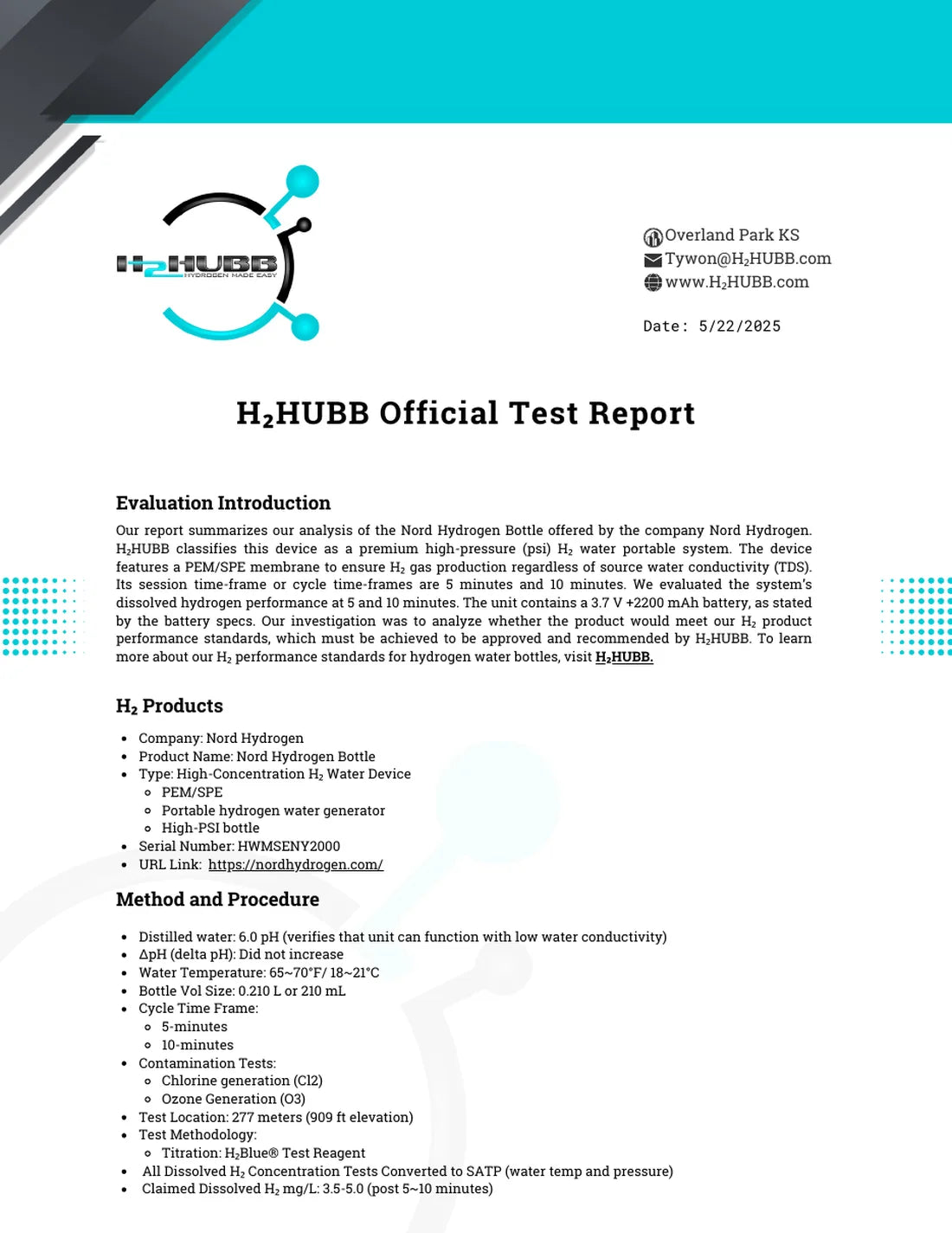
First page of the H₂HUBB official test report for the Nord Hydrogen Bottle
H₂HUBB, an independent hydrogen product reviewer · Kansas · 22 May 2025

A second test, a different method

Official test report · serial HWMSENY2000

4.75 mg/L
10-min average · SD 0.10 · peak 5.01
≈ 1.0 mg
H₂ per fill · 10 min
2.83 mg/L
5-min average · SD 0.12 · peak 3.20
None detected
chlorine (Cl₂) · ozone (O₃)

Method. H2Blue® titration reagent, distilled water at pH 6.0 and 18–21 °C, bottle filled to the base of the threads, multiple runs averaged and converted to standard temperature and pressure. The lab also checked the water for chlorine and ozone, the two by-products a poorly separated cell can release.

How to read it. Titration is a good field method but less precise than gas chromatography, and the water was cooler. The two results land within about 8% of each other on the 10-minute cycle. On the 5-minute cycle the gap is larger, about 18%. The GC result itself varied by about ±13% between runs, so expect your own bottle to land somewhere in that range.

Full report (PDF)

Nord Inhale 2.0
H₂HUBB · Overland Park, Kansas · 22 May 2025

Nord Inhale 2.0: hydrogen flow rate

Official test report · Level 4 inhalation device

661 mL/min
H₂ measured · rated 600
93%
electrolytic cell efficiency
44–60 mL
H₂ per inhalation, Pulse Mode
70–80%
of breaths receive the pulse

Method. Alicat H₂ mass flow meter and gas displacement. Distilled water at 18–21 °C, 900 mL/min mode, 10-minute warm-up, gas passed through a dryer and a humidity/temperature sensor before the flow meter; average of at least three one-hour runs, converted to standard conditions. Electrical values measured at the cells: 6.72 V, 23.46 A across four cells in series.

Full report (PDF)   See Nord Inhale 2.0

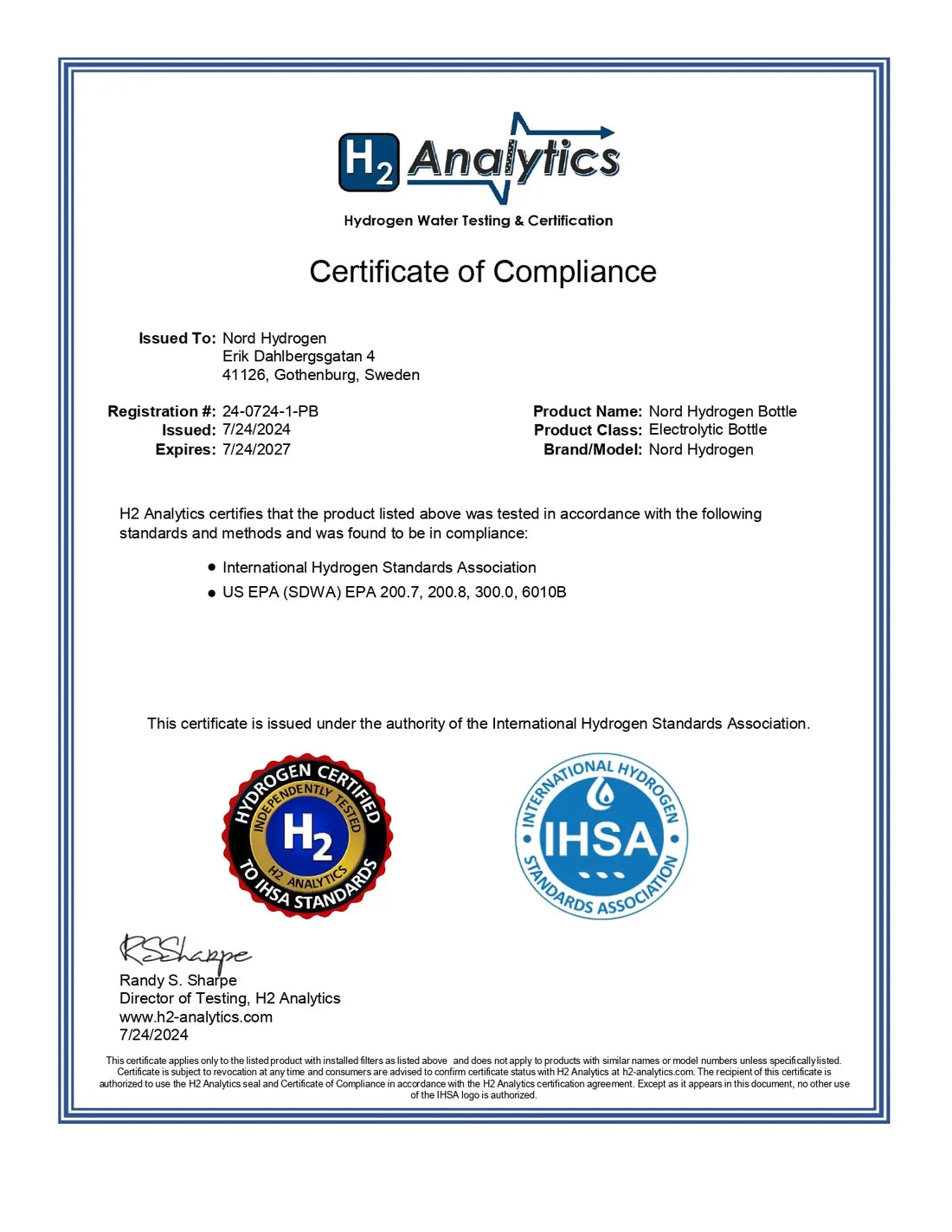
IHSA certificate of compliance for the Nord Hydrogen Bottle
International Hydrogen Standards Association

IHSA certificate of compliance

IHSA is an independent body of researchers that defines what counts as hydrogen water, how it should be measured, and which labs are authorised to test it. Our certification testing was carried out by H2 Analytics, one of those labs.

What certification means, and doesn't. It confirms the bottle meets IHSA's minimum standard. It's a floor, not a ranking: it doesn't say one certified product is better than another. That's why we publish the actual numbers too.

Open certificate (PDF)

H2Blue titration
1. Run a 10-min cycle
2. Add drops until the
   blue stops fading
3. Count drops → mg/L
Check it yourself

Don't take our word for it.

H2Blue titration drops, the same method H₂HUBB used, let you measure your own bottle at home in about two minutes. It's the most direct way to know what's in your glass, today and in a year.

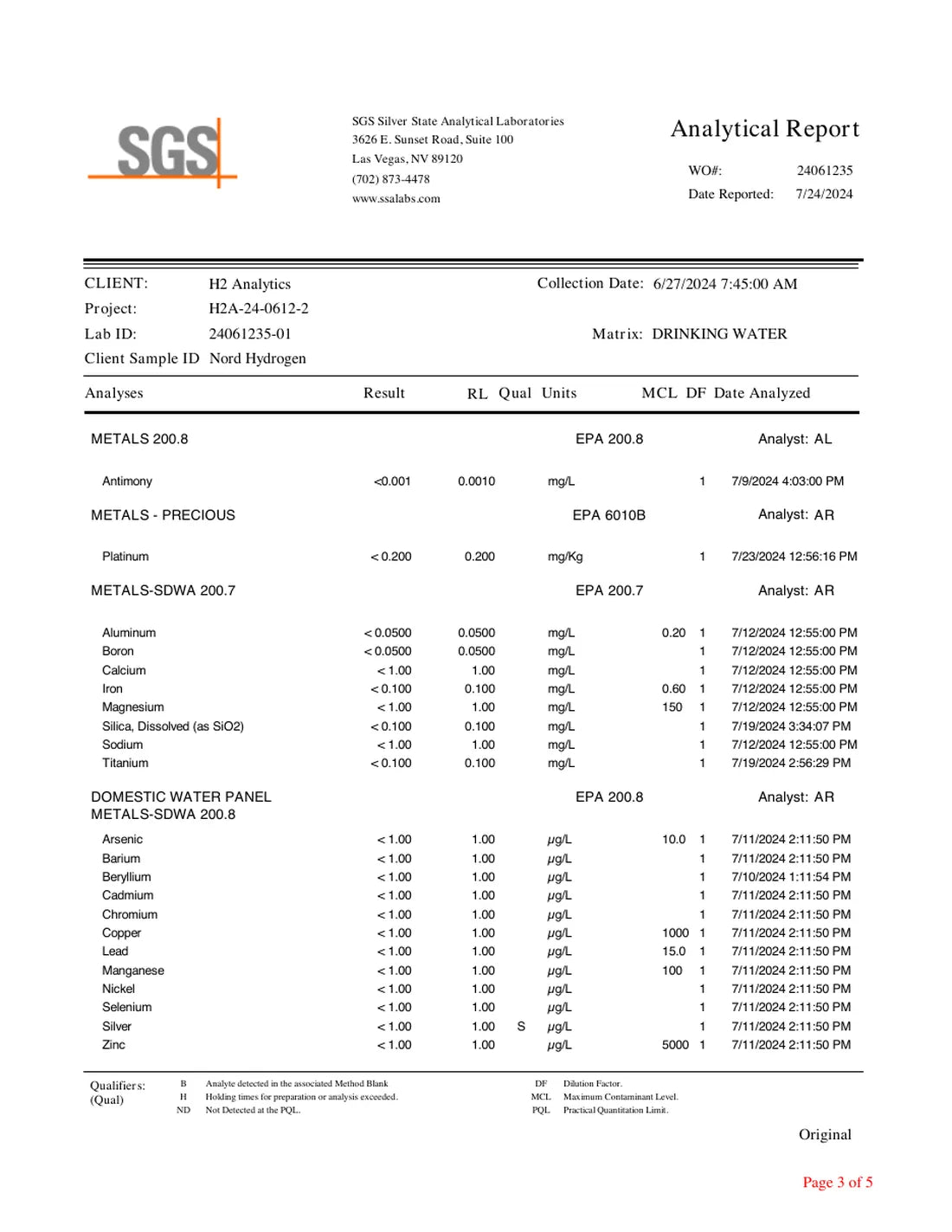
SGS analytical report page with metals results for the Nord Hydrogen sample
SGS Silver State Analytical Laboratories · Las Vegas · 24 July 2024

Metals in the water, including the electrodes' own

Work order 24061235 · sample "Nord Hydrogen" · commissioned via H2 Analytics

Not detected
platinum · titanium, the electrode materials
Not detected
lead · cadmium · arsenic · chromium · nickel
< 1 µg/L
every trace metal tested, 12 of 12
Not detected
aluminium · iron · copper · antimony · cyanide

Method. Water from the bottle, analysed by ICP to US EPA methods 200.7, 200.8 and 6010B, plus the standard US domestic water panel. Results below the lab's quantitation limit are reported as not detected.

Why it matters. A PEM cell runs current through platinum-coated titanium. If the coating or the cell were poor, those metals would show up in the water. They didn't, and neither did any of the heavy metals on the panel.

How to read it. The test used mineral-free water, so calcium, magnesium and hardness read zero by design. pH and odour were measured after their holding time had passed (the lab's "H" flag), so those two values aren't meaningful for drinking water.

Full report (PDF)

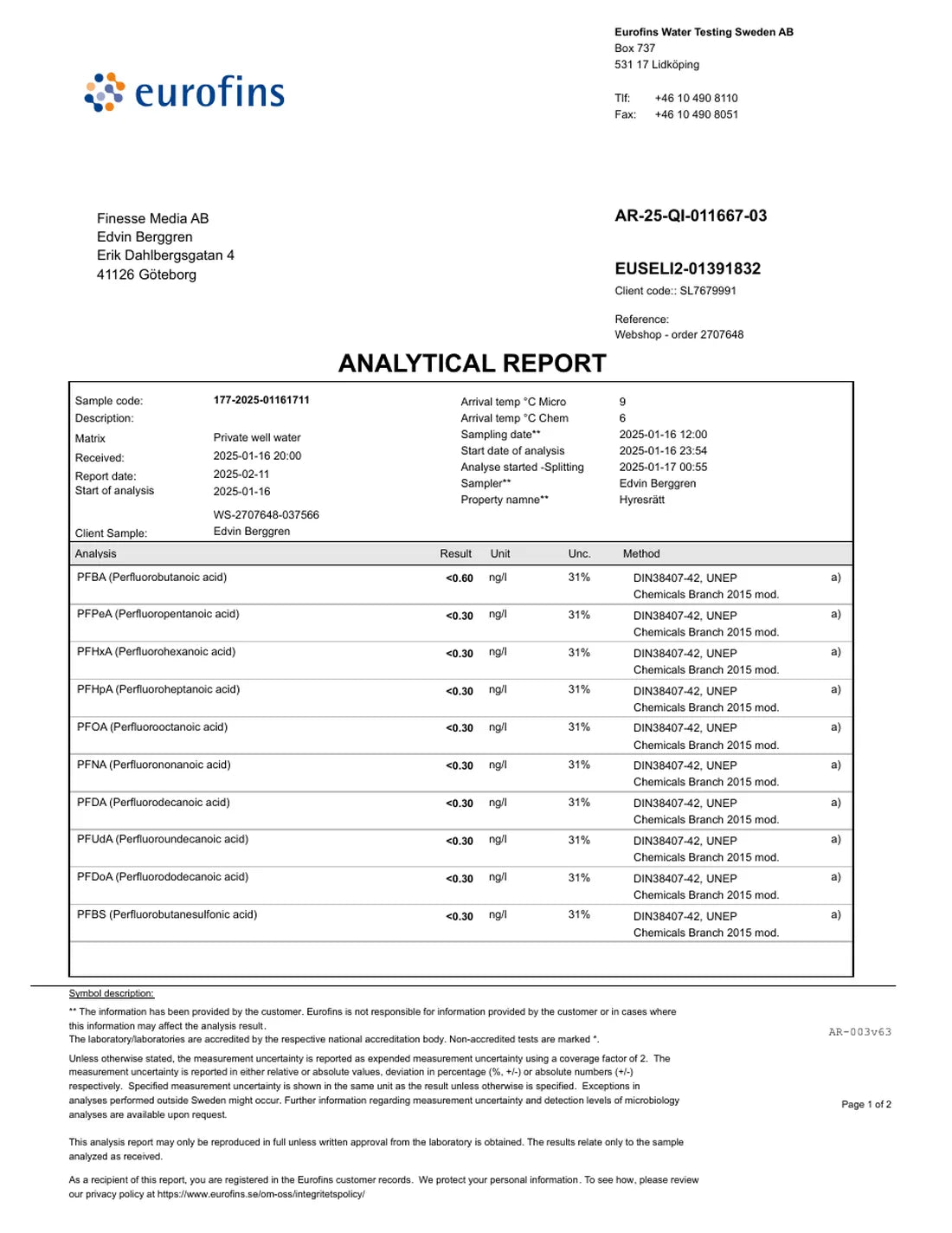
Eurofins Sweden analytical report with PFAS results
Eurofins Water Testing Sweden · Lidköping · 11 February 2025

PFAS: none detected

Report AR-25-QI-011667-03 · SWEDAC-accredited lab (ISO/IEC 17025)

21 of 21
PFAS compounds below detection
ND
sum of PFAS 4 (EU EFSA)
ND
sum of PFAS 21 (Swedish LIVSFS 2022:12)
< 0.3 ng/L
PFOA · PFOS < 0.2 ng/L

Method. DIN 38407-42 by LC-MS/MS at Eurofins Food & Feed Testing Sweden. It covers the 21 PFAS compounds regulated in Swedish drinking water from 2026, including the four the EU food safety authority tracks together.

Why it matters. PFAS, the "forever chemicals", are used in some plastics and coatings. Testing the water that has been in the bottle shows none were detected at detection limits of about 0.3 ng/L, far below the Swedish limit of 4 ng/L for the PFAS 4 sum.

Full report (PDF)

Third-party reports are reproduced unedited. Any statements in them about health effects are the lab's, not claims we make about the bottle.

Check any bottle, including ours

Six questions to ask before you buy hydrogen anything.