Free shipping across EuropeIHSA certified1-year warranty

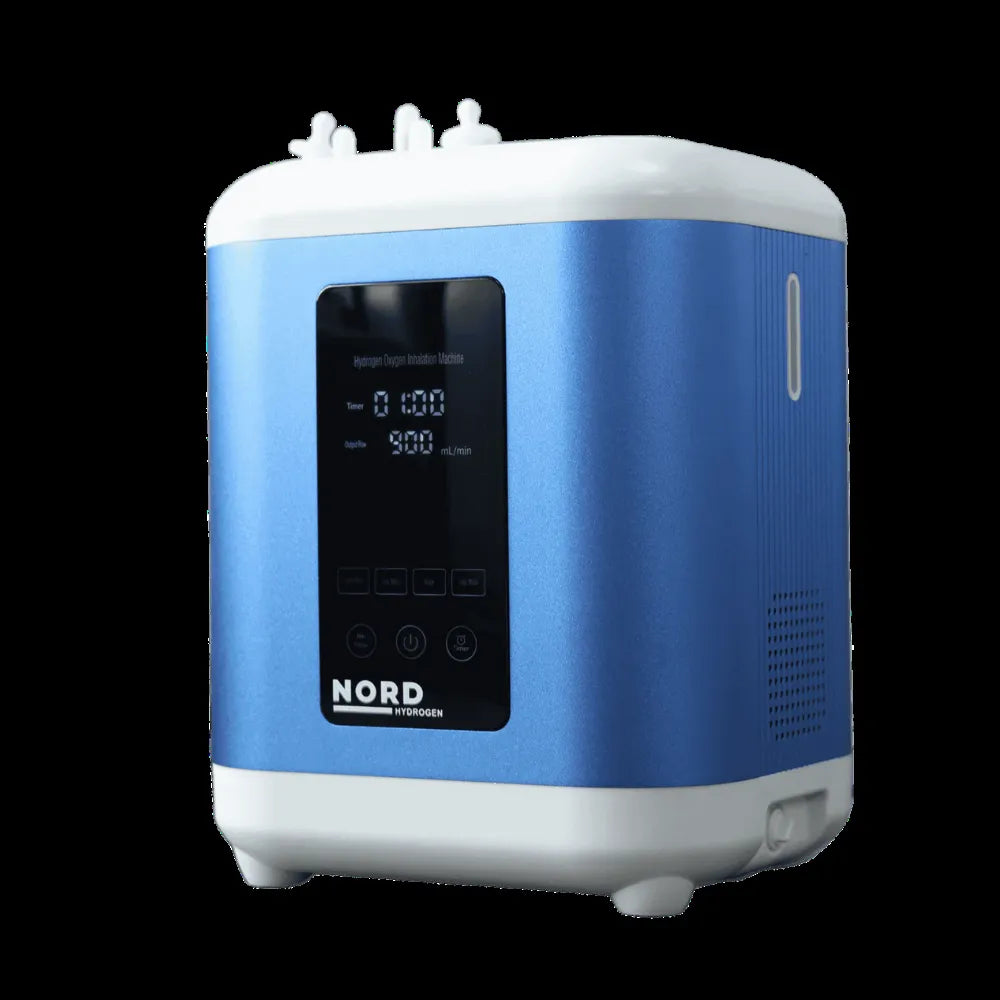
Nord Inhale 2.0

"A significant innovation that sets the Nord Inhale 2.0 apart."Tywon Hubbard, H₂HUBB
€2.269incl. VAT · free shipping across Europe
  • 661 mL/min H₂ measured by H₂HUBB, 10% above the rated 600
  • Pulse Mode: pulses of up to 1,322 mL/min, 2–3× the hydrogen per breath
  • Four PEM/SPE cells at 93% efficiency, oxygen vented separately
  • Sessions from 1 to 6 hours, runs on distilled water
KlarnaVisaMastercardApple PayGoogle PayPayPalAmerican ExpressShop Pay
ZeroWater Starter Kit Add the ZeroWater Starter KitThe Inhale needs mineral-free water. ZeroWater gives TDS 000 straight from the tap, no distilling. + €84
  • Free shipping3–5 working days
  • CE & RoHSCertified
  • 1-year warrantyRepairs in Gothenburg
  • Setup helpVideo guide + email
What's in the box
  • 1× Nord Inhale 2.0
  • 1× Silicone nasal cannula
  • 1× Power cable
  • 1× User manual, with video instructions
Specifications
  • H₂ output600 mL/min rated · 661 mL/min measured
  • Flow settings150–900 mL/min total gas
  • Cells4 × PEM/SPE, platinum-coated titanium
  • Timer1–6 hours, sleep mode
  • Reservoir1,000 mL distilled water, ~10 mL used per hour
  • Power115 V or 220 V · 324 W rated
  • Size · weight38 × 30 × 30 cm · approx. 5.4 kg
Tests & certificates
  • H₂ flow rate661 mL/minH₂HUBB
  • Electrical safetyCE-LVDEN 60335-1
  • ElectromagneticCE-EMCEN IEC 55014
  • Hazardous substancesRoHS2011/65/EU

All documents in the Proof Center

Safety

Hydrogen is flammable. The Inhale has low-water protection, internal fans against gas build-up, a gas separator, deionisation filters and heat vents. Keep the cannula tip away from open flames, sparks and cigarettes, and use it in a normally ventilated room. More on safety

Shipping & returns

Free shipping across Europe, usually 3–5 working days. Returns follow our returns policy. One-year Nord warranty on top of your legal consumer rights, with service in Gothenburg.

Nord Hydrogen · True Stories
“I didn’t want hype. I wanted data, something proven to work.”

Raluca Ril · holistic health coach and speaker, seven months with Nord Inhale

After years of chronic health challenges, Raluca went looking for an inhaler with a strict list. This is why she chose Nord.

  • Third-party tested“A device that had third-party testing and was proven to produce therapeutic levels of hydrogen.”
  • Runs continuously“Other brands, you have to stop every hour and wait 30 minutes. That was not realistic for me.”
  • Can be used at night“For someone managing chronic health challenges, that makes a big difference.”
  • Low maintenance, for the whole family“Easy to maintain… it can be used by multiple family members.”

“It has become an essential part of supporting my health. And I don’t say that lightly.”

How Nord Inhale
compares:

Nord InhaleOther inhalers
Pulse Mode: 2–3× the hydrogen per breath, peaks of 1,322 mL/minVery rare
661 mL/min measured, 10% above the ratingOften just the rating
93% cell efficiency, four PEM cellsRarely published
Pure hydrogen at the cannula, O₂ vented separatelyMixed-gas units count O₂ in the flow
Distilled water only, no lyeAlkaline units need lye
EU company: repairs and spare parts in Sweden, no customsOften shipped from the US or China
MHI-trained support teamSales support
Measured, not rated

More than wepromised.

H₂HUBB measured the Inhale's output with an Alicat mass flow meter over one-hour sessions. It came in above our own spec.

661
mL/min H₂ measured · rated 600
54.5
mg of H₂ per minute
93%
electrolytic cell efficiency
Level 4
H₂HUBB inhalation ranking

H₂HUBB official test report, 22 May 2025. Distilled water, 18–21 °C, 900 mL/min mode (600 H₂ + 300 O₂ rated), 10-minute warm-up, average of at least three runs, converted to standard conditions. Read the report →

Pulse Mode

Twice the hydrogen per breath,without twice the machine.

With a nasal cannula, gas that flows while you breathe out is simply lost. Pulse Mode stores the hydrogen made between breaths and releases it the moment you inhale, as a pulse of up to 1,322 mL/min: twice the continuous flow, and up to 8.8% hydrogen in the breath you take. Watch where the gas goes.

H₂ flow now1,322 mL/min
H₂ into you per breath44–60 mL

Live graph of hydrogen flow. With Pulse Mode, hydrogen made while you breathe out is stored and released as a pulse of up to 1,322 mL/min the moment you breathe in, delivering 44 to 60 mL per breath. On continuous flow it stays at about 661 mL/min and the gas that flows while you breathe out is lost, about 22 mL reaches you per breath.

1,322
mL/min momentary peak as you breathe in
2–3×
hydrogen per breath vs continuous
44–60 mL
H₂ per synced inhalation
up to 8.8%
inhaled H₂ concentration, cannula

Measured by H₂HUBB, official test report, 22 May 2025: pulse delivery of 44–60.5 mL per enhanced inhalation on 70–80% of breaths, "effectively doubling, and in some instances tripling" inhaled concentration, about 4.0–8.8% per enhanced breath. The graph is an illustration at a resting 12 breaths a minute: peak shown as twice the measured 661 mL/min; ≈ 22 mL is 11 mL/s over a two-second inhale.

Is 661 mL/min enough?

Right in thetherapeutic range.

In inhalation, "every company in the hydrogen space has something to sell," as H₂HUBB puts it. Makers of each design argue theirs is the only one that works. So here are the numbers from H₂HUBB, an independent tester that sells no machines.

Therapeutic range through a nasal cannula · 150–960 mL/min
120H₂HUBB minimum
300Clinical study with significant benefits
661Nord Inhale 2.0, measured
02505007501,000 mL/min
1–4% is the clinical target

Human studies mostly use 1–4% hydrogen in the air you breathe. At a resting 6 L/min, H₂HUBB estimates a cannula device needs roughly 150–960 mL/min to get there. Nord Inhale measures 661.

Pulse Mode fixes the weak spot

H₂HUBB names exhale losses as the main limitation of nasal-cannula devices, and names pulse mode as the exception. Ours lifts delivery to 44–60 mL per breath, up to 8.8% inhaled.

Pure PEM, no oxygen worries

PEM/SPE is what H₂HUBB calls the gold standard for purity: over 99.9% hydrogen, no combustible mix inside the device. And at 300 mL/min, blood oxygen differed by just 0.8 points in a 2026 trial, not clinically significant.

Three designs. Each maker says theirs is best.

Pure hydrogen (PEM/SPE)Nord Inhale 2.0Hydrogen mixed with airOxyhydrogen / Brown's gas
What it makes>99.9% pure H₂, oxygen vented separatelyPure H₂ premixed with air to 1–4%H₂ and O₂ together, 2:1, from lye electrolyte
Inhaled H₂Scales with flow; up to 8.8% per breath with Pulse ModeCapped at about 4% by designHigh at high flows
H₂HUBB's view"Gold standard for purity"; no combustible mix inside the deviceSafest by design, but "therapeutically capped" for higher-dose useCombustible through the whole gas path; caustic electrolyte to handle
UpkeepDistilled water, drain monthlyLowElectrolyte, flame arrestors, plate wear
Myth"Pure hydrogen through a cannula starves you of oxygen."

Breathing nothing but hydrogen from a sealed mask would, which is why Nord uses an open nasal cannula. Every breath mixes with room air: even at the 8.8% H₂ peak in Pulse Mode, the air you breathe still holds about 19% oxygen, against 21% normally.

Myth"1–4% is all you'll ever need."

Research shows a dose response: higher inhaled concentrations often outperform lower ones, and human studies have used 5–12%. A 4% ceiling is a design limit, not a finding.

Myth"If it isn't H₂ + air, it's unsafe."

Safety comes from engineering and use: enclosed gas paths, valves, shut-offs, and no flames or sparks nearby. Pure-H₂ systems have been used in many human trials.

Myth"Brown's gas is superior."

No head-to-head human trial shows it. Where it seems to win, it's usually just more hydrogen reaching the body.

Source: H₂HUBB, Hydrogen Inhalation Therapy guide, and the H₂HUBB test report for Nord Inhale 2.0 (22 May 2025). The 300 mL/min study is Botek et al., 2022 (post-COVID rehabilitation); the oxygen study is a 2026 randomised crossover trial in 20 active women. Inhaled concentration varies with breathing.

Safety first

Hydrogen is flammable.We treat it that way.

Inhalation is the one form of hydrogen where safety really matters. Here's what the device does, and what we ask you to do.

01

Low-water protection

The cells shut down before they can run dry and overheat.

02

Internal fans

Keep air moving inside the housing so hydrogen can't build up if there's ever a leak.

03

Separate oxygen vent

Hydrogen and oxygen leave through separate ports, so the cannula carries pure hydrogen.

04

Gas separator & filters

A gas separator and deionisation resin keep the output above 99.9% hydrogen.

05

Heat vents

Dedicated vents stop the cells and electronics from overheating during long sessions.

06

Your part

No open flames, sparks or smoking near the cannula tip. Use it in a normally ventilated room and only with distilled water.

Reviews

What customers say.

Improved recovery - and LDL

“At 51 years old, working as a coach part-time and also really interested in anything interesting that comes up - Nord hydrogen Inhale has absolutely improved my recovery from intense workouts. Also, to my surprise, looks like it also lowered my LDL cholesterol. I read about this from Ben Pakulskis IG. It did sound a bit funny to be honest, but my blood tests confirm that.”

Sami S.Nov 10, 2025via Trustpilot

Only with inhale 2.0 u really feel the effect

“… The Nordhydrogen inhale 2.0 on the other hand seems to have a real effect but its hard to explain the feeling after inhaling hydrogen for an hour. What i did test was my physical performance directly after inhaling hydrogen and what i found was that i had significantly less difficulty while planking (exercise). On a sidenote i also reached a new lowest resting heart rate of 51 bpm (measured with HRM pro plus from garmin) during my sleep … Also i found the manual to be a bit lacking in details but it's easy to figure out how everything works. …”

TobiasMay 29, 2025via Trustpilot

Read all reviews on Trustpilot

FAQ

Inhale questions.

What water does it need?

Only distilled or fully demineralised water. Minerals damage the membranes. A ZeroWater filter gets tap water to TDS 000 without distilling. Change the water about every 30 days; it uses around 10 mL an hour.

How long is a session?

You set the timer from 1 to 6 hours. It takes 20–30 minutes of breathing for hydrogen levels in the body to level out, so most people run it for at least that long.

Inhale or bottle: what's the difference?

They're different routes. Drinking puts hydrogen through the gut and liver; inhaling delivers it through the lungs to the bloodstream. They're studied separately and one doesn't replace the other. More on the science

Is it loud?

You'll hear the internal fans, similar to a small air purifier. Sleep mode dims the display for evening sessions.

What if something breaks?

A one-year Nord warranty, with service and repairs in Gothenburg. Write to info@nordhydrogen.com.

Prefer to drink it?

The Nord Hydrogen Bottle.

5.14 mg/L in ten minutes, anywhere you go. €214.